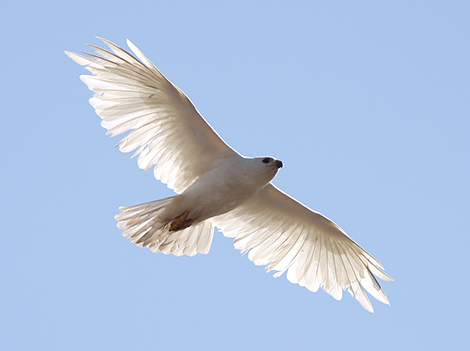
This plumage variation of Red-tailed Hawks, although not necessarily rare in
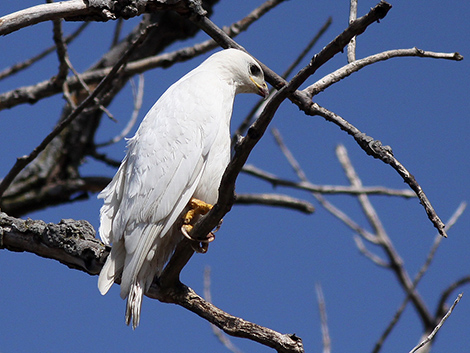
occurrence, is somewhat rare in opportunities to photograph. When I first saw the bird, it was perched in a tree directly above me. The lighting was perfect as you can see in this photo below:
However, when the bird left this perch and began to soar overhead, lighting conditions changed drastically. The bird never ventured into the favorable deep blue sky where the lighting and background are ideal. Instead, the bird stayed near the sun, creating a problematic backlighting situation.
Trying to photograph an all white bird is difficult with any of the automatic modes on your camera, because your camera’s light meter will want to make the white bird a neutral gray (see our previous article about the “gray snow problem“).
So, the best way to get a good exposure of a bird like this, is to use manual exposure and follow the simple “Sunny 16 Rule.”
Sunny 16 Rule
The Sunny 16 Rule basically states that under bright and unfiltered sunlight, the correct exposure for a front lit object of even tones would be f/16 at 1/(ISO speed). That means if you’re shooting at ISO 200, then the correct exposure at f/16 would be 1/200 second. But, this is just a starting point.
Here’s a table with more “Sunny 16” examples:
| f/16 | f/11 | f/8 | f/5.6 | f/4 |
| 1/200 | 1/400 | 1/800 | 1/1600 | 1/3200 |
| f/16 | f/11 | f/8 | f/5.6 | f/4 |
| 1/400 | 1/800 | 1/1600 | 1/3200 | 1/6400 |
Photographing a raptor in flight requires shutter speeds of at least 1/800 second, but preferably over 1/1600 second.
So, using a Canon EF 400mm f/5.6 lens, you could say that the proper exposure for a well lit and even-toned subject would be f/5.6 at 1/3200 second, more than ample shutter speed for flight photography.
The Sunny 16 rule is just a starting point…
In the perched shot, lighting was ideal. However, in this case with an almost white bird, we do not have an evenly toned subject. So what do we do? The bird’s bright white feathers would surely be washed out if I used the Sunny 16 Rule as is. So, a minor adjustment was made. By stopping down 1/3 of an f-stop I shot this photo at f/5.6 at 1/4000 second. The resulting exposure was perfect.
When the bird took to the air and soared closer to the sun, the bright translucent feathers on the trailing edge of the wings were almost blinding! But the underneath portion of the bird was in the shade. Not having enough time to take a shot and inspect its histogram, I decided to expose for the brightest part–the trailing edge–and hoped the undersides would not be too dark.
Use your camera’s dials for quick changes
One option I took advantage of was the ability to jog back and forth stopping down with the shutter speed dial between 1/3 (1/4000) and 2/3 (1/5000) f-stops. The photos taken at 1/5000 were best with the brightest feathers and the undersides still showing ample detail.
It is important to be able to make adjustments with both f-stop and shutter speed on the fly, so to speak. There’s a reason those controls are so close to your fingers!
If you enjoyed this article, and would like to read more, please signup for free updates by email or RSS.
 About the Author: Vic Berardi is a raptor lover that lives in the Midwest. He is the founder of the Illinois Beach State Park Hawk Watch and every weekend of the year you’ll find him searching for hawks and photographing them. Several of his photographs have been published in a leading raptor journal and in articles he has written. During the year he gives presentations teaching others about hawks and hawk migration. Vic also photographs dragonflies and wild flowers and is always respectful of nature and its creatures..
Just saw a white phase Red-tailed Hawk in Edwards County, Illinois, just north of Albion. It is a gorgeous bird. Since I didn’t have a camera, I’m glad you published yours here. I found another good piece about them written by a man named Guthrie from New York.
Hello I was looking at your photo. My sons school district uses the white hawk for it’s mascot. I was looking at your photos.
A majestic white hawk just flew in front of our cottage on Grand Lake St Marys, near Montezuma, Ohio. I was enthralled by its appearance so I searched the web and found this site. Thank you so much for posting this.
Thank you Rebecca!
2 wonderful shots of a rare specimen done with rapid adjustments! You had a little time since the beginning was the perch, but my mind would not have processed the problems so quikcly. I would have relied on software after the fact. And I now know I need to use quicker shutter speeds for raptors — I thought 1/200 would be fast enough. Off to the forest preserve with a camera.
Thanks! Glad you got something out of the article!
Thanks for the tips. I have the same trouble exposing great egrets properly. I get lucky once in a while but want to increase my keeper rate.
Thank you Craig! Sometimes you may have to adjust exposure while you’re shooting. I keep my index finger on the shutter speed dial and frequently will move it to a faster or slower speed as the lighting on a bird changes during flight.
I live in Madison WI, My son and I saw one very large white hawk last summer. It was stalking my neighbours small dogs and tried to steel his baby chihuahua. A blond one was also visiting. We had two that we know of here. A white and a blonde. They were both larger then the average hawks and sounded like an eagle. The white one was the biggest.
Good Luck and thank you for sharing.