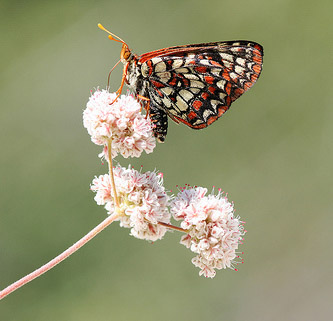
They start out as a hungry slow-moving blob and through the process of metamorphosis, they transform themselves into a winged insect exhibiting a wonderful array of contrasting colors. Some species migrate thousands of miles for the winter, and many species have remarkable features like eyespots that help protect them from predators.
Naturally, you’ve probably wanted to photograph these amazing little creatures, so here are some tips on how to do it:
1 – Use a fast shutter speed
Butterflies spend most of their time flying around collecting nectar from wildflowers. And, as you probably know, these wildflowers are very fragile. Even on a “calm” day, they can be seen bouncing through the air. To make matters worse, the butterfly never seems to stand still either. To battle this constant movement and help freeze the action, it’s important to use a fast shutter (increasing your ISO to 400 or 800 can help with this).
2 – Take lots of photos
When you’re photographing butterflies, three things are constantly moving: the butterfly, whatever it’s perched on, and your camera. To ensure you get a shot when all three are perfectly still, take lots of shots.
3 – Keep your camera parallel to the butterfly’s wings
You only get one geometrical plane of complete sharpness, so you always want to put as much of your subject in this plane as possible. With butterflies, you’ll want its body and wings tack sharp, so make sure your camera’s sensor is parallel to them.
4 – Look for them in cooler weather
Although you’ll probably see a lot more butterflies on warm sunny days, they’re actually easier to photograph on cooler overcast days. In order to fly, they need the heat of the sun to warm up their wings, so on cloudy days it’s extremely difficult for them to fly. This will allow you to get much closer to them without scaring them away and it gives you more time to carefully compose your shot.
5 – Shoot when the butterfly is frontlit or backlit by the sun
In order to help highlight the butterfly’s beautiful pattern of colors, it’s usually best to photograph them when they’re front-lit or back-lit by the sun. The main thing you want to avoid is sidelight, because it usually casts harsh shadows on their wings, making it extremely difficult to get a good exposure.
6 – Use a tripod, but keep the head loose
Since you’ll need a longer lens to photograph butterflies, it’s important to keep your camera steady. You can use a tripod to help steady your camera, but keep the head loose, so you can quickly point the camera in a new direction when the butterfly moves. A ballhead works great in these situations.
7 – Learn about butterfly species in your area
If you’re looking for places to photograph butterflies, then one of the best things you can do is learn about the species in your area. Some species have a very small range and can only be found in a few “hotspots,” so picking up a book on butterflies can help you discover these “hotspots.” If you’re in southern California, I can highly recommend the book An Introduction to Southern California Butterflies.
Be patient, and have fun!
Sometimes photographing butterflies can be frustrating: either you’re waiting for a butterfly to land on a flower right in front of you, or the wind picks up right before you start pressing that shutter button. So, most importantly, remember to be patient and have fun! Enjoy watching these amazing creatures, and if you happen to capture a nice photo of them, great! 🙂
Get more great tips in our free weekly newsletter.

 About the Author: Steve Berardi is a naturalist, photographer, software engineer, and founder of PhotoNaturalist. You can usually find him hiking in the beautiful mountains and deserts of southern California.
Great tips, thank you for sharing. I’m just trying to learn digital photography and appreciate all the help I can get.
Great tips! I’m going to use them the next time I visit a local butterfly house.
Regarding tip #1 and ISO speed. If your camera supports it enable ISO speed increments in 1/3 stops versus 1 stop. Doing so gives you 4 additional speeds to select from in the 100 – 400 range (100, 125, 160, 200, 250, 320, 400). The lower you can keep your ISO the less noise you’ll have to deal with.
Regarding tip #3, I’ll stick with RAW. If I can’t get the shot I want before the buffer fills I’ll recompose and try again.
@Zack – I usually avoid those odd ISO speeds (i.e. 50, 160, etc) because on most cameras they’re just digital interpolations (like “digital zoom”). Sticking with the 100/200/400/800 speeds also makes exposure adjustments easier to calculate because they’re all a 1-stop difference.
Interesting observation, Steve. I’ll need to dig into that subject a little deeper.
Nice post and great photo. I like taking photos of butterflies when they’re back lit too as this can shine throough the wing like stained-glass.
@Ian – Good point. Backlighting definitely works too (as long as you can keep the sun from shining on your lens).. It’s really just sidelighting you want to avoid, so you don’t get those harsh shadows on the wings/body.
Fantastic tips, Steve! The ISO speed and tripod suggestions are wonderful, and I’ll put them to good use – as soon as I get my tripod with a ball head 🙂
Good tips steve ! we’re from kerala, india and we also do have some tips from our observations to share. you may find them here
http://enchantingkerala.org/digital-photography-school/14-tips-for-photographing-butterflies.php
would like your take on it. kindly let us know what you think by posting a comment. warm regards from India.
Thanks so much for your tips. I have been able to get some good images, but with your tips I will get great images. Thanks again….