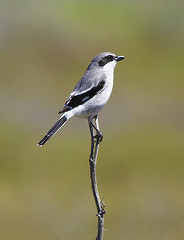
This helps the viewer immediately focus on the subject, but should that always be your goal?
When you choose not to isolate your subject against it’s background, you can reveal much more about your subject (such as it’s habitat, size, what it might be doing at the moment, etc).
Here are a few examples to help illustrate what I mean:
Red-shouldered Hawk perched on a tree
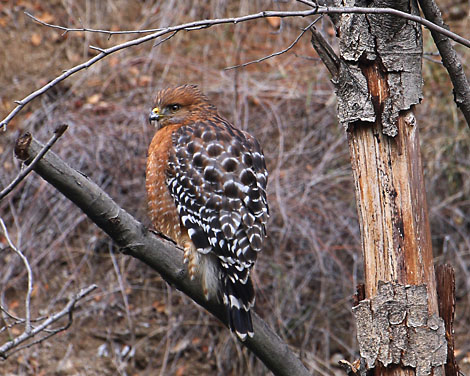
When I first saw this Red Shouldered Hawk, I really wanted a photo where the background was completely out of focus, so all the viewer really saw would be the hawk and the branch it was perched on. I knew I was much too far away to get this kind of shot, but I took a photo anyway because this was the first time I saw a red shouldered hawk 🙂
When I looked at the photo later when I got home, I actually changed my mind and decided I liked the shot better this way (with the background somewhat in focus). Here’s why: it helps show how much the hawk has adapted to his surroundings and blends in with his background. If the background was completely out of focus, this effect wouldn’t have been illustrated very well.
Having the background just slightly out of focus also helps paint a picture of the hawk’s habitat, whereas a totally isolated hawk would just look like a big bird in front of a mysterious out of focus background.
Allen’s Hummingbird Perched on Ocotillo
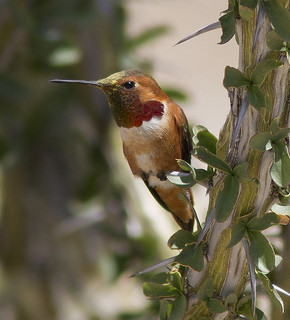
When I first saw this Allen’s hummingbird, I had a vision of photographing it perched on this Ocotillo, but with the blue sky in the background instead of more Ocotillo. I waited around for about an hour, hoping it would land where I wanted it to, but it just kept perching low to the ground.
So, I finally just snapped a few photos anyway. Just like the hawk photo above, I didn’t like this shot at first, but then later changed my mind and thought this was a good photo for similar reasons: it helps show the environment of the bird. With all that pollen on the hummingbird’s head, the viewer might even assume (correctly) that it’s been busy gathering nectar from Ocotillo flowers all day 🙂
What do you think?
Agree? Disagree? Please share your thoughts with us by leaving a comment below. Thanks! 🙂
Get more great tips in our free weekly newsletter.
 About the Author: Steve Berardi is a naturalist, photographer, software engineer, and founder of PhotoNaturalist. You can usually find him hiking in the beautiful mountains and deserts of southern California.
Ahhhh Steve love this post….as much as I would love to isolate my subject matter…I love the contast of the natural environment look and feel. Most of my shots that I take are like above with background. I don’t have many that have a background that is out of focus…I guess really it’s about you as a photographer…what your looking for in your photography. I’ve grown alot over the last few months and I’m learning something new everyday!! Going on a masive Hiking Trip into the interior of BC this month. Canoeing, hiking and also taking a trip to the Glacier peakes as well. My objective is more scenic shots since I haven’t mastered them yet…I’ve tried but have failed badly. Also hoping for some Bear shots, Elk, and I’m hopeful for an Owl. I will try and say hi when I get home maybe I will have something fabulous to show for my trip!! Again thanks for this wonderful post.
Crista Cowan
Victoria BC
Canada
Crista – good point that “it’s about you as a photographer” — it’s really easy sometimes to get bogged down by all the “rules” and forget your original reason of why you take photos in the first place. I think for everyone this reason is different, and everyone should take this into consideration when deciding to obey a “rule” 🙂
Your massive hiking trip sounds great! Wish I had a trip like that planned for this summer. Good luck with the landscape photos! Will there be “spirit bears” where you’re going? I saw photos of them recently.. pretty amazing looking animals..
Steve
Well Steve if I luck out and see one I will definately photograph it. I just bought an excellent Camera Case for my adventure. I needed more room for batteries…don’t want to be caught without extra’s that’s for sure. Have you checked out Steven Kazlowski’s photo’s of the Spirit Bears. He has captured the images close to where I’m headed. Hard to believe that these beautiful bears are related to the Black Bear. I expect to definately see Black..but if I see a Spirit I will definately not miss that opportunity. I’m headed into the mountains of Whistler accually…there are alot of lakes there and opportunities to hike into the lush forests. As well as take the opportunity to hike up the mountain sides. I love to stretch my long legs Steve does the soul good….
Sometimes you don’t have an option. If the animal you’re after is not cooperating, sometimes it is enough to just get the shot. One of the things I enjoy most about wildlife photography is you never know quite what you’re going to get! A chance encounter with an unexpected anilmal in an awkward place can often yield a shot which is artistically suboptimal – but more than worth it just for the sentimental value. But it is is good to know what it is you’re setting out to achieve.
@Crista – I have seen Steven Kazlowski’s spirit bear photos – they’re amazing! Hope you have a good trip!
@Ian – Good point! Most wildlife is so unpredictable, that you don’t have much time to make quick adjustments in settings and/or composition. Just getting the photo is often 90% of the work 🙂